
- All
- Product Name
- Product Keyword
- Product Model
- Product Summary
- Product Description
- Multi Field Search
 English
 Views: 30 Author: Site Editor Publish Time: 2025-12-02 Origin: Site
In every brewery—whether a small craft workshop, a microbrewery, or a fully automated commercial plant—the mash system sits at the very center of the brewing process. It is not only the first step toward converting raw ingredients into beer; it is the decisive stage that shapes flavor, body, aroma, fermentability, clarity, and overall beer quality.
Mashing is the controlled process of mixing milled malt with hot water to activate enzymes. These enzymes convert insoluble starches into fermentable sugars, which later become alcohol during fermentation.
In practical terms, the mash system determines:
How sweet or dry the beer will be
Its alcohol level (ABV)
Its body and mouthfeel
Color, clarity, and stability
Foam retention
Aroma and flavor layers
Brewers often say: “Great beer begins in the mash tun.” This is not a slogan—it is a scientific fact. The mash process transforms grain from solid carbohydrates into a liquid known as wort. Without this transformation, yeast would not have any sugar to ferment, and brewing would not be possible.

For a brewery to operate consistently and profitably, the mash system must be stable, efficient, and built to precise engineering standards. DEGONG’s experience in global brewing projects shows that a well-designed mash system brings advantages in four critical dimensions:
2.1 Flavor Consistency
Temperature stability and correct mixing ensure enzymes function properly. Even a 1–2°C deviation can affect beer body and alcohol level. High-precision mash systems guarantee repeatable flavor across batches.
2.2 Brewing Efficiency
Efficient conversion results in higher extract yield. This reduces malt usage per batch—an important economic advantage for commercial breweries.
2.3 Flexibility for Many Beer Styles
A modern mash system must support:
Light lagers
IPAs and double IPAs
Stouts and porters
Wheat beers
Sour beers
Specialty beers
Different styles require different mash schedules. A high-precision system allows breweries to adapt without compromising quality.
2.4 Scalability
As breweries grow, the mash system must scale from 500L to 1000L, 2000L, 5000L, and beyond.
DEGONG designs modular systems that allow seamless expansion without redesigning the entire brewhouse.

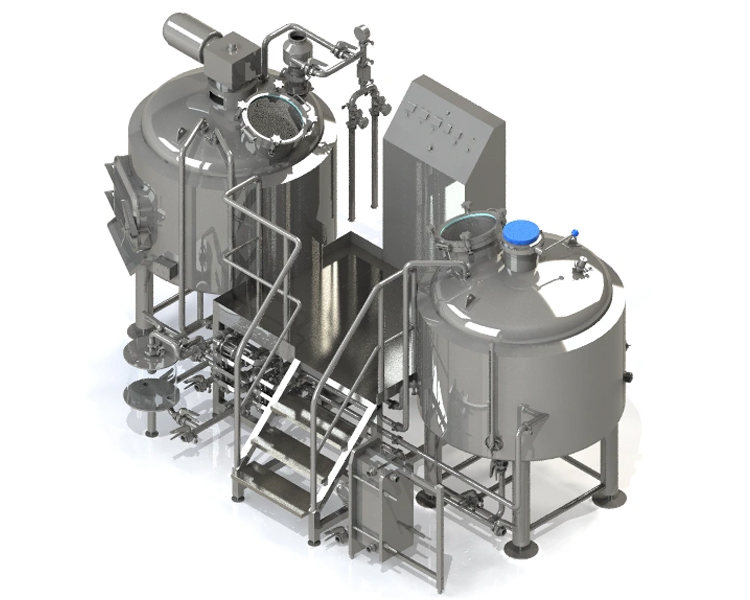
A complete mash system typically includes:
The main vessel where starch-to-sugar conversion occurs. A DEGONG mash tun features:
Steam or electric heating
Full-variable mixing paddles
Temperature-controlled jacket
Precise thermal uniformity
Sanitary stainless-steel construction
CIP cleaning system
Optimized geometry for enzyme activity
This vessel separates sweet wort from spent grain. Key design details include:
Saw-tooth false bottom
Raking and sparging system
Adjustable rake height
Knife-edge grain cutting
Uniform wort collection
Fast lautering speed
High extraction efficiency
For microbreweries and small craft breweries, DEGONG offers a combined mash and lauter vessel—an economical but highly efficient solution.
Prepares brewing water at the correct temperature.
Good water preparation = stable mash quality.
A mash system is not only vessels—it is also:
Flow control
Temperature control
Automated step heating
Recirculation
CIP cleaning
Sanitary valves & piping
DEGONG can integrate Siemens/PLC control for fully automated mash profiles.
Different mash techniques create different beer characteristics. Professional equipment should support all brewing methods.
Most common in craft breweries. Advantages:
Simple
Fast
Ideal for well-modified malt
Produces clean beer flavor
Temperature increases in stages, activating different enzymes:
Protein rest (45–55°C)
Maltose rest (62–65°C)
Saccharification (68–72°C)
Mash-out (75–78°C)
Gives precise control over body, fermentability, and foam stability.
Traditional method used in many lager breweries. A portion of mash is removed, boiled, and returned. Produces:
Deeper malt flavor
Richer color
Smooth mouthfeel
Stable foam
DEGONG systems can be customized for decoction brewhouses.

5.1 Body & Mouthfeel
Lower mash temperatures (62–65°C) → more fermentable sugars → dry, crisp beer
Higher mash temperatures (67–72°C) → more dextrins → fuller body
5.2 Alcohol Content
More sugar conversion → higher ABV
Poor conversion → lower alcohol and thin flavor
5.3 Color & Clarity
Lautering efficiency determines clarity
Mash pH affects final color
5.4 Foam Stability
Protein management during mashing is essential for a stable beer head.
5.5 Aroma & Flavor Layers
Proper enzyme activity unlocks malt complexity and balances hop character.